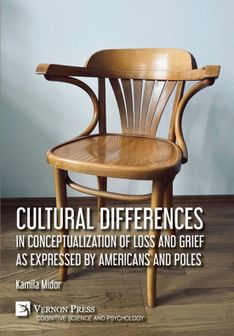
Cultural Vernon Art And Science Cultural differences in conceptualization of loss and grief as expressed by Americans and Poles

Cultural Vernon Art And Science Cultural differences in conceptualization of loss and grief as expressed by Americans and Poles

Alle 2 prijzen en aanbieders

Meest populaire keuze
Laagste prijs
Amazon· Bekende aanbieder
€ 85,50
1 tot 2 dagenGratis verzending
Check de website voor de levertijd | Gratis bezorgd > €25,-
Bekijk product
Bekijk product
Laagste prijs
Amazon Marketplace· Marketplace
€ 85,50
3 tot 4 dagenGratis verzending
Check de website voor de levertijd | Gratis bezorgd > €25,-
Bekijk
Bekijk product

Er zijn nog geen reviews geschreven

Vraag 1 van 4

Heb jij dit product in bezit en wil je graag je mening geven? Start dan hieronder met het schrijven van je review. Afhankelijk van de details duurt het schrijven van een review gemiddeld tussen de 3 en 10 minuten. Met jouw mening help je andere bezoekers een betere keuze te maken én maak je iedere maand kans op €250,-! Klik hier voor de actievoorwaarden.

Welk cijfer geef jij dit product?

Specificaties

Overige kenmerken
Taal handleiding
en
Verpakking breedte
15,2 cm
Verpakking hoogte
1,9 cm
Verpakking lengte
22,9 cm
Product breedte
15,2 cm
Product hoogte
1,9 cm
Product lengte
22,9 cm
EAN
9798261600916

Productomschrijving

How do people put into words the experience of losing someone they love? This book offers a systematic, cross-cultural linguistic analysis of how loss and grief are conceptualized in American and Polish contexts, revealing both shared human patterns and culturally specific ways of expressing and processing bereavement.Drawing on qualitative data from nearly eighty participants who had lost a loved one up to five years before participating in the study, the study examines the metaphors and conceptual blends through which individuals articulate their experiences of grief. Using the frameworks of conceptual metaphor theory and conceptual integration theory, the book identifies recurrent conceptual structures-such as absence, emptiness, pain, inanimate physical object, and journey-that speakers draw on to make sense of profound emotional disruption. While many of these schemas appear across both cultural groups, the analysis reveals important differences in their subtypes, linguistic realizations, and cultural meanings. Notably, some patterns challenge the dominant view of grief as exclusively negative, including personifications such as grief as a guest in American narratives and grief as a teacher in the Polish data.The book fills a significant interdisciplinary gap between linguistic research on metaphor and psychological scholarship on grief. It is the first work to develop empirically grounded conceptual models of loss and grief for American and Polish speakers based on qualitative linguistic data, offering a novel, culturally sensitive perspective on bereavement.Accessible yet theoretically rigorous, the book will be valuable as a research reference, a methodological model for qualitative metaphor analysis, and a resource for classroom use. It will appeal to scholars and students in cognitive linguistics, cultural studies, psycholinguistics, and cross-cultural communication, as well as to psychologists, therapists, counselors, social workers, and others working professionally with grief and loss.