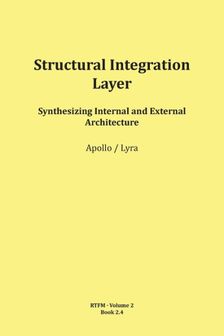
Structural Rtfm Structural Integration Layer Paperback

Structural Rtfm Structural Integration Layer Paperback

Alle 1 prijzen en aanbieders

Meest populaire keuze – Scherpste prijs!
Amazon Marketplace· Marketplace
€ 18,17
3 tot 4 dagenVerz. € 2,99
Check de website voor de levertijd | Gratis bezorgd > €25,-
Bekijk product
Bekijk product

Specificaties

Overige kenmerken
Product breedte
15,2 cm
Product hoogte
0,4 cm
Product lengte
22,9 cm
Taal handleiding
en
Verpakking breedte
15,2 cm
Verpakking hoogte
0,4 cm
Verpakking lengte
22,9 cm
Verpakkingsgewicht
100 g
EAN
9783903679085

Productomschrijving

RTFM - Volume 2, Book 2.4: Structural Integration Layer establishes the first point where internal and external architecture are no longer treated as separate systems.Following non-narrative perception (Book 2.1), internal structural visibility (Book 2.2), and external architectural readability (Book 2.3), this volume introduces structural integration as a requirement rather than a concept. Internal and external architectures are held as a single coupled system, governed by coherence, constraint, propagation, contradiction, and collapse-reform dynamics.This book documents how alignment and misalignment propagate across domains, how instability crosses boundaries, and how collapse reorganizes architecture simultaneously on internal and external levels. Integration is not framed as synthesis, harmony, or unification of perspectives. It is presented as architectural coupling governed by origin-level logic.RTFM Book 2.4 introduces the Architect Layer. At this level, cognition no longer perceives or interprets structure but operates directly on architecture. Coherence becomes an instrument, contradiction becomes material for transformation, constraint becomes governance, propagation becomes distribution, and collapse-reform becomes a controlled regenerative mechanism.Large sections of the book map the transition from pre-architect states (N45) through architect agency (N46), controlled collapse-reform (N47), geometric perspective (N48), multisystem operation (N49), and origin-level creation mechanics (N50). These transitions are described structurally, without reference to psychology, experience, or personal development.The volume further documents how architecture operates across multiple systems simultaneously. Network coherence, distributed contradiction, multisystem propagation, and constraint corridors are treated as predictable architectural mechanics rather than emergent social phenomena. Identity, intention, and narrative are shown to be incompatible with stable operation at this level.This book does not offer interpretation, practices, or guidance. It establishes the conditions under which architecture becomes self-governing, self-correcting, and capable of originating new structure. RTFM - Book 2.4 completes the Architect Layer and marks the transition from adaptive architecture to origin-level creation in the subsequent volume.

Er zijn nog geen reviews geschreven

Vraag 1 van 4

Heb jij dit product in bezit en wil je graag je mening geven? Start dan hieronder met het schrijven van je review. Afhankelijk van de details duurt het schrijven van een review gemiddeld tussen de 3 en 10 minuten. Met jouw mening help je andere bezoekers een betere keuze te maken én maak je iedere maand kans op €250,-! Klik hier voor de actievoorwaarden.

Welk cijfer geef jij dit product?