
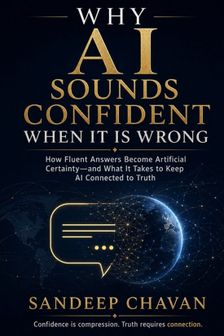
Why Gyrus Vision Why AI Sounds Confident When It Is Wrong

Why Gyrus Vision Why AI Sounds Confident When It Is Wrong

Alle 2 prijzen en aanbieders

Meest populaire keuze – Scherpste prijs!
Amazon· Bekende aanbieder
€ 107,52
3 tot 4 dagenVerz. € 9,99
Check de website voor de levertijd | Gratis bezorgd > €20,-
Bekijk product
Bekijk product
Amazon Marketplace· Marketplace
€ 107,52
3 tot 4 dagenVerz. € 9,99
Check de website voor de levertijd | Gratis bezorgd > €20,-
Bekijk product
Bekijk product

Specificaties

Overige kenmerken
Product breedte
15,2 cm
Product hoogte
2,9 cm
Product lengte
22,9 cm
Taal handleiding
en
Verpakking breedte
15,2 cm
Verpakking hoogte
2,9 cm
Verpakking lengte
22,9 cm
Verpakkingsgewicht
676 g
EAN
9788168977600

Productomschrijving

Why can an artificial intelligence system be completely wrong-and still sound as composed, precise, and convincing as when it is right?Why AI Sounds Confident When It Is Wrong examines one of the most important problems in the age of generative AI: the gap between fluent output and justified knowledge.Sandeep Chavan argues that artificial confidence should not simply be explained as machine arrogance, intention, belief, or even hallucination. A generative system does not need to "believe" a false answer in the human sense. It needs only to convert an open prompt into a resolved output. Once one path becomes language, the alternatives, assumptions, missing evidence, and unresolved uncertainty that preceded it may disappear from view.The result is the confidence paradox: the system resolves an answer, the human interprets that resolution as confidence, and confidence may then be interpreted as evidence of knowledge.Using the Chavanian Axioms as a structural diagnostic framework, the book follows this process from prompt to consequence:Delta ¿ resolution ¿ constrained geometry ¿ collapse ¿ residue ¿ irreversible output ¿ human interpretation ¿ institutional authorityThe analysis moves beyond AI hallucinations to explore large language models, human confidence, probability and decoding, RLHF and reward shaping, retrieval-augmented systems, citations and false anchors, automated decision systems, prompting, human oversight, uncertainty, abstention, escalation, and AI governance.The book introduces several important distinctions:Fluency is not belief.Probability is not truth.Retrieval is not verification.Human presence is not necessarily meaningful oversight.Automation is not legitimate authority.Correction does not erase consequence.Chavan also develops the idea of an epistemic circuit: reliable AI use requires connection beyond the generated answer-to evidence, current sources, measurement, context, independent comparison, human judgment, accountability, contestability, and correction.This is not an anti-AI argument. The manuscript recognizes generative AI as a powerful technology for explanation, synthesis, research, creativity, and decision support. Its concern is proportionality: the greater the authority assigned to an AI output, the stronger the surrounding epistemic circuit must become.Written for AI users, developers, educators, researchers, managers, professionals, policymakers, and readers interested in artificial intelligence and society, this book asks a question increasingly important in an age of abundant answers: When the answer sounds finished, what remains unresolved beneath it?

Er zijn nog geen reviews geschreven

Vraag 1 van 4

Heb jij dit product in bezit en wil je graag je mening geven? Start dan hieronder met het schrijven van je review. Afhankelijk van de details duurt het schrijven van een review gemiddeld tussen de 3 en 10 minuten. Met jouw mening help je andere bezoekers een betere keuze te maken én maak je iedere maand kans op €250,-! Klik hier voor de actievoorwaarden.

Welk cijfer geef jij dit product?