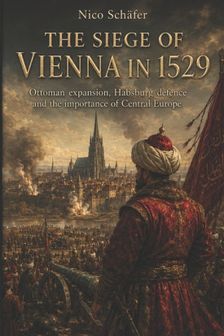
Ottoman expansion, Habsburg defence and the importance of Central Europe
In the autumn of 1529, Vienna faced one of the greatest military challenges in its history. Sultan Süleyman I led a powerful Ottoman army to the walls of the Habsburg city. But why did the Sultan move to Vienna in the first place? What role did the Battle of Mohács, the collapse of the Kingdom of Hungary and the power struggle between Ferdinand von Habsburg and Johann Zápolya play? And why did the Ottomans not succeed in taking Vienna despite their numerical superiority?
This book tells the story of the first siege of Vienna in an understandable, chronological and political context. It begins with the rise of the Ottoman Empire and the strategic importance of Hungary, leads through the defeat at Mohács and the Hungarian throne dispute to Süleyman's campaign of 1529. Afterwards, the focus is on the defense of Vienna, the battles for walls and breaches, the use of cannons and mines, and the last major Ottoman attack.
It's not just about battles and military leaders. The book also explains the interests of the Habsburgs, the goals of Süleyman, the difficult situation of Johann Zápolya and the effects of the war on the population. It shows how much logistics, weather, supplies, fortress construction and political decisions could determine the course of a campaign.
Particular attention is paid to the question of why Vienna withstood in 1529. This avoids widespread simplifications. Neither the bad weather alone nor an alleged technical inferiority of the Ottomans explain the failure. Rather, long supply routes, the loss of heavy siege artillery, the advanced season and a determined, well-organized defense collided.
The long-term consequences are also considered. The siege was not a final victory over the Ottoman Empire. The battle for Hungary continued, Buda was occupied by the Ottoman in 1541 and Central Europe developed into a border area between the Habsburgs and Ottomans that had been fought over for decades. At the same time, numerous legends emerged around 1529, which still shape the image of the siege today.
This book is aimed at history buffs who want to get a well-founded and easily understandable overview of the siege of Vienna in 1529. It is deliberately not an academic textbook for historians, but a descriptive introduction for readers who want to understand events, backgrounds and contexts without having to work through specialist academic literature.
>Parts of the text have been revised with the support of artificial intelligence. It was used as a tool in structuring, research and linguistic elaboration. The contents have been carefully edited, historically classified and checked for factual consistency. In this way, the book combines modern working methods with the claim to offer a serious, understandable and high-quality presentation.